
NASSCO rebuilt its pipeline, lateral and manhole recertification as a 13-module self-paced eLearning series
A failing legacy course became a 13-module self-paced recertification series with a 98% exam pass rate, and NASSCO's recertification capacity doubled.
-
98%
exam pass rate, against 92% in the instructor-led program
-
2x
recertification capacity
-
7 months
to recover the investment
About NASSCO
2026 Brandon Hall Group Gold: Best Custom Content and Best Certification Program
NASSCO is the industry association dedicated to the assessment, maintenance and rehabilitation of underground infrastructure. Founded in 1976, it sets the standards for the wastewater industry through its Pipeline, Lateral and Manhole Assessment Certification Programs (PACP, LACP and MACP).
More than 20,000 active certified professionals across the Americas use these certifications to apply one consistent coding language. Their data informs billions of dollars in public infrastructure spending decisions each year.
Demand for recertification outgrew the classroom
NASSCO's certified camera operators, inspectors, engineers and system owners must recertify every three years. The instructor-led program delivered outstanding results, but each class was capped at 15 students, and the 230+ sessions needed each year far exceeded NASSCO's trainer capacity.
Many professionals could not find a session in time and had to retake the full three-day initial certification at $1,240. A classroom recertification could cost up to $3,000 once travel, lodging and lost productivity were counted. On top of that, 25 to 30% of NASSCO's certified trainer network is expected to retire in the next decade.
Then the Version 8 Manual introduced hundreds of granular coding changes across all three certification tracks. The existing eLearning course had module-breaking errors and paths that let learners skip content, so the whole course had to be rebuilt from the ground up, and it had to work from the moment it launched to win back stakeholders' trust.
How the series was designed
-
The manual as a reference
Rather than digitizing lecture slides, the Custom Learning team designed a Manual-as-Reference approach that trains technicians to find and apply the Version 8 Manual under realistic field conditions, the way they use it during an inspection.
-
Simulations that mirror the service vehicle
The workforce has deep field expertise and varying levels of digital literacy, so the simulations mirror the CCTV monitors and inspection software technicians use in their service vehicles every day.
-
Field-form data entry
Data entry exercises follow the standard field inspection form in the same order as an actual inspection.
-
Corrective feedback
Wrong answers point to the specific manual page. Waiting periods between exam retakes send learners back to the course material, so a failed attempt becomes a guided review.
-
Progressive difficulty
Foundational coding builds to high-stakes defect discrimination and close distinctions such as fracture versus crack.
-
Auditable completion
Forced-completion architecture means every interaction is engaged before learners move on, which gives the credentialing body auditable proof of 100% content completion.
Inside the course
-
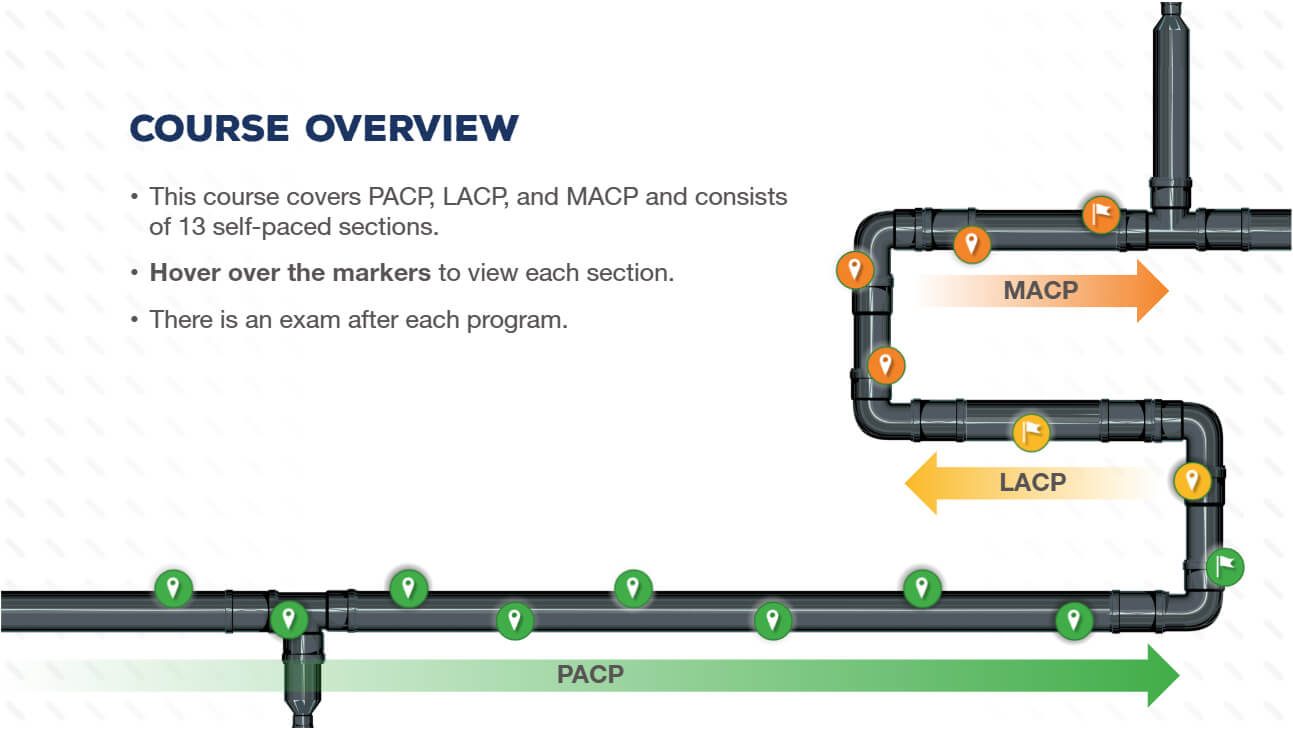
The course map: 13 self-paced sections across PACP, LACP and MACP -

Coding hinge defects from CCTV footage -

A knowledge check: code the photo from the details table -

Wrong answers point back to the manual page -

Basics of the PACP manual -

A video lesson on operation and maintenance codes -

Estimating clock references in open entry fields -

Structural coding: hole descriptors
-
Project goals
- Give the whole certified workforce a self-paced way to recertify alongside the instructor-led program
- Train technicians to navigate and apply the Version 8 Manual as they would in the field
- Give the credentialing body proof of 100% content completion
- Reach learners with varying digital literacy through mobile delivery, a digital manual and audio narration
-
Challenges
- Classes were capped at 15 students, and the 230+ sessions needed each year far exceeded trainer capacity
- The Version 8 Manual brought hundreds of coding changes across PACP, LACP and MACP
- The previous course's module-breaking errors and content-skipping paths meant a full rebuild
- The new course had to work from the moment it launched to win back stakeholders' trust
The result
The 13-module series has a 98% exam pass rate, against 92% in the instructor-led program, and 85% of learners recommend it. More than 1,200 learners completed it in its first year, and NASSCO's recertification capacity doubled.
The investment was recovered within seven months of launch. There have been no module-breaking errors since launch, and the program's quality led NASSCO's board and leadership to approve a self-paced initial certification course. It will be the first time initial PACP, LACP and MACP certification is available outside a live classroom since the program launched in 2002.
Instructor-led training remains part of NASSCO's program, and its enrollment stayed strong after the eLearning series launched.
- Self-paced enrollment costs $775, with no travel and no days away from the field
- About 24 hours of course time, typically completed within three weeks of enrollment
- Mobile delivery through the Go.Learn app
What NASSCO says
-
It enables us to reach a larger audience with fewer resources while maintaining the high standards expected of the program. The result is more efficient operations and better overall experience for everyone involved.
 Heather Myers, Program Director, NASSCO
-
Types of interactivity
- CCTV inspection simulations
- Manual-as-Reference exercises
- Field-form data entry
- Immediate corrective feedback
- Structured exam remediation
- Forced-completion navigation
- Audio narration
- Digital Version 8 Manual
- Mobile delivery
-
Where the content started
Existing instructor-led materials, reimagined for the Version 8 Manual.
How can we help with a program like this?
Tell us what you're working on and we'll suggest where to start. We reply within three business hours.

Hello, I'm Sonia, and I'm here to help you.
SMB Sales

Hello, I'm Josh, and I'm here to help you.
Senior Sales Director

Hello, I'm Philip, and I'm here to help you.
Senior Sales Director

Hello, I'm Alan, and I'm here to help you.
Account Manager

Hello, I'm Jennifer, and I'm here to help you.
Leader, Custom Learning Team

Hello, I'm Brayden, and I'm here to help you.
Senior Sales Director